

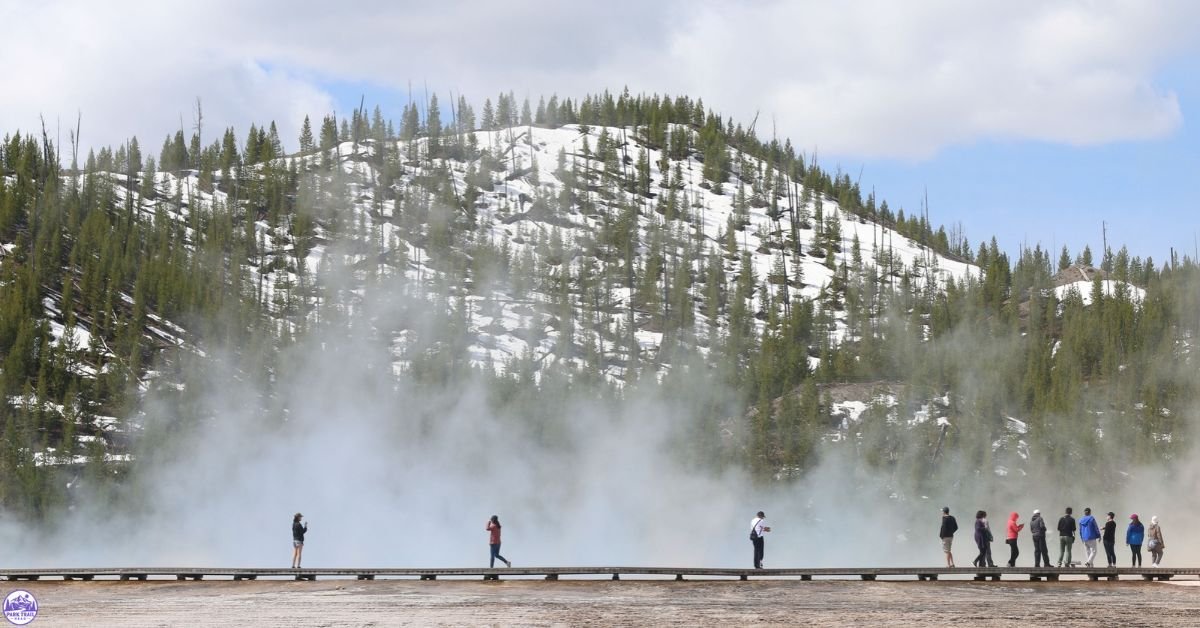
Old Faithful is one of the most recognizable sights in Yellowstone National Park, but its eruptions do not happen at perfectly scheduled times. The Old Faithful schedule is based on a prediction window that changes after each eruption. Understanding that window can help you decide when to reach the viewing area, whether there is time for a short walk, and how to plan the rest of your day.
Rangers use the duration of the previous eruption to estimate when the next one will occur. A shorter eruption usually leads to a shorter interval, while a longer eruption means a longer wait. The prediction also includes a margin of approximately 10 minutes, so arriving at the exact posted time is not a good strategy.
This guide explains how Old Faithful predictions work, where to check the latest information, which viewing areas are worth considering, and what to do while you wait.
Old Faithful is one of Yellowstone’s most famous sights, but it is only one part of a much bigger park. To plan the rest of your visit, explore our guide to the best Yellowstone park activities, including geyser basins, canyon viewpoints, wildlife areas, and scenic drives.
Quick Answer: How Often Does Old Faithful Erupt?
Old Faithful’s next eruption is generally predicted using the duration of its previous eruption:
- After an eruption lasting less than three minutes, the next eruption is estimated in about 68 minutes.
- After an eruption lasting more than three minutes, the estimate is about 94 minutes.
- Both predictions have a margin of approximately 10 minutes.
These are prediction intervals, not guaranteed appointment times. Check the latest information on the NPS Current Geyser Activity page, in the official NPS app, or at the Old Faithful Visitor Education Center when it is operating.
The Old Faithful Schedule Is a Prediction, Not a Timetable
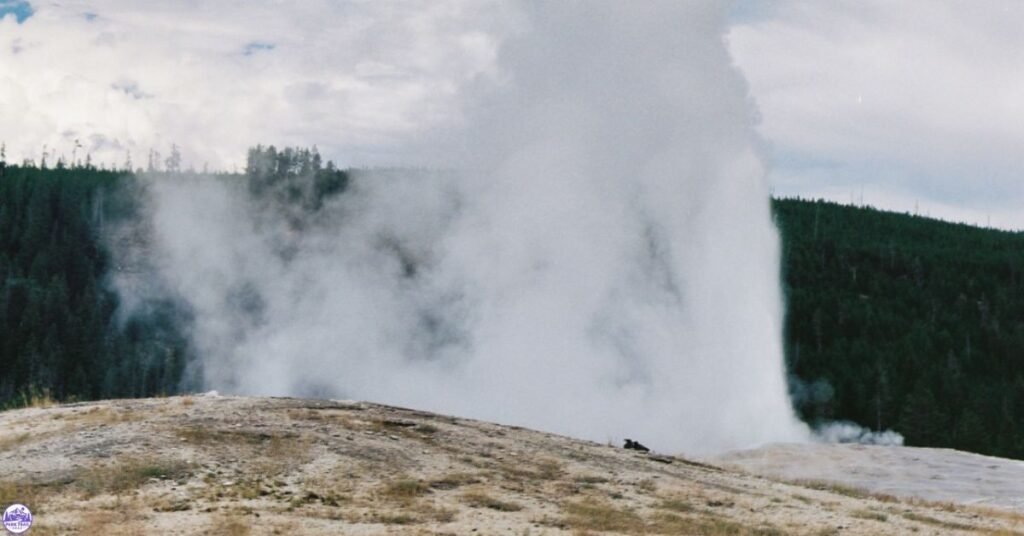
The name Old Faithful can make the geyser sound more predictable than it really is. Although it is one of Yellowstone’s most dependable geysers, it has never followed an exact hourly schedule.
For example, a prediction of 2:30 p.m. does not mean the eruption will begin at precisely 2:30. It indicates an estimated time, with a margin on either side.
The reason rangers can make these predictions is the relationship between an eruption’s duration and the time needed for the geyser to recharge. A shorter eruption releases less water and heat, so the next eruption usually happens sooner. A longer eruption releases more, meaning the system generally needs additional time before erupting again.
There is another important limitation: the calculation is useful for estimating the next eruption, not for building a reliable schedule for the entire day. Once another eruption takes place, check for a new prediction rather than relying on an older estimate.
Old Faithful’s behavior has also changed over time. According to the National Park Service, the interval between eruptions has lengthened by about 30 minutes over the past 30 years. Changes within the geyser’s underground plumbing and earthquakes have contributed to these variations.
For that reason, older travel guides and fixed eruption schedules should not replace the latest NPS prediction.
Old Faithful Eruption Times: Short vs. Long Eruptions
The three-minute mark is central to the basic prediction method.
The NPS geyser activity table lists two usual intervals: 68 minutes after a short eruption and 94 minutes after a longer one. Both include a margin of plus or minus 10 minutes.
| Previous eruption | Estimated interval before the next eruption | Planning advice |
| Under 3 minutes | About 68 minutes (±10) | Stay close if you want to watch the next eruption |
| Over 3 minutes | About 94 minutes (±10) | You may have time for a short walk nearby |
| Exactly around 3 minutes | Borderline | Use the ranger-posted prediction rather than relying on your own calculation |
An eruption itself usually lasts between 1.5 and 5 minutes. The water can reach approximately 106 to more than 180 feet, with an average height of around 130 feet.
It is also useful to understand the difference between a typical prediction interval and a historical average. The NPS Old Faithful area page reports a median interval of 102 minutes, with intervals ranging from 54 to 118 minutes, as of January 2025. That figure describes observed behavior over time. It is not a replacement for the next-eruption prediction based on the previous eruption.
You can review these details on the NPS Old Faithful area page and the Current Geyser Activity page.
Where to Find the Next Old Faithful Prediction
You do not need to guess when the next eruption will happen. Yellowstone provides several ways to check the estimated time.
Old Faithful Visitor Education Center: During operating hours, this is a useful place to find the latest prediction and learn more about the geyser. The center also displays information about other predictable geysers in Yellowstone.
Nearby lodges: Prediction information is also posted at lodges in the Old Faithful area. Check the display when you arrive, particularly if you are staying nearby.
Official NPS app: The free National Park Service app is useful for checking park information while exploring Yellowstone. Download the relevant park information before your visit so you have access when mobile service is limited.
NPS Current Geyser Activity page: This is one of the best places to check before driving to the Old Faithful area. It provides the latest available eruption predictions and links to additional information.
GeyserTimes: This website shares geyser observations and eruption information. It can be a helpful additional reference, especially when official prediction services are unavailable.
Live webcam: The NPS Old Faithful area page also provides access to a live-streaming view. It is useful for checking whether an eruption has begun or for following the geyser from another location.
There are two details worth remembering when using these tools.
First, NPS says the last prediction can remain displayed until a new one becomes available. Therefore, an old time on a screen does not necessarily mean a fresh prediction has been made.
Second, predictions may be unavailable while the visitor education center is closed. The NPS activity page specifically warns about seasonal gaps, typically around early November to mid-December and mid-March to mid-April.
Check the latest visitor center operating information and park operating dates before relying on an in-person prediction.
How to Calculate the Next Old Faithful Eruption Yourself
You can estimate the next eruption with a watch and a little attention. The National Park Service even provides a classroom activity that explains the basic method.
Follow these four steps:
- Record the start time. Start timing when water begins splashing continuously out of the geyser cone.
- Record the end time. Stop when the eruption has ended and only steam remains.
- Calculate the duration. Subtract the start time from the end time and round the result to the nearest half-minute.
- Add the expected interval. Add 68 minutes for an eruption shorter than three minutes or 94 minutes for one longer than three minutes.
Here is a simple example.
Suppose an eruption begins at 2:10 p.m. and lasts two and a half minutes. Because it is shorter than three minutes, use the 68-minute interval.
2:10 p.m. + 68 minutes = 3:18 p.m.
Your estimated next eruption time is 3:18 p.m., with a margin of approximately 10 minutes.
This calculation is helpful for understanding the process, but it should not replace the latest ranger prediction. If your eruption lasts exactly three minutes or falls close to the dividing point, let the posted estimate guide your plans.
You can follow the official instructions in the NPS Predict Old Faithful classroom activity.
How Accurate Is the Old Faithful Schedule?
Old Faithful predictions are useful, but they are not exact.
The National Park Service describes the prediction margin as approximately plus or minus 10 minutes. In other words, a prediction of 3:18 p.m. gives you an estimated window of 3:08 to 3:28 p.m.
NPS also reports that predictions are accurate within the 10-minute variation about 90 percent of the time. That is a strong record for a natural feature, but it still leaves room for variation.
For a better viewing experience, reach the seating area before the early edge of the prediction window. Arriving 10 to 15 minutes before the posted estimate gives you extra time to find a suitable place and settle in.
Try not to schedule a meal, a long drive, or another timed activity immediately before the predicted eruption. The geyser may erupt earlier than the central estimate.
A prediction should also be treated cautiously when the previous eruption lasted close to three minutes. That duration sits near the dividing point between the two usual intervals. In that situation, use the updated NPS prediction rather than trying to force your own calculation into one category.
Best Places to Watch Old Faithful Erupt
You have several viewing choices around the Old Faithful area. The best option depends on how much walking you want to do, whether you are visiting with children, and how much time you have available.
| Viewing location | Best suited for | What to consider |
| Main viewing area | Families, first-time visitors, and easy access | Popular location with limited space during busy periods |
| Old Faithful boardwalks | Visitors who want to explore nearby thermal features | Stay on designated paths and allow time to return |
| Old Faithful Inn porch | An elevated view from near the historic inn | Access and available space can vary |
| Observation Point | Visitors looking for a wider view of the basin | Requires an uphill hike |
| Live webcam | Checking activity from another location | Does not replace seeing the eruption in person |
The main viewing area is the simplest choice for most visitors. It is less than a quarter-mile from the visitor education center and has wide walkways that provide accessible routes.
The Old Faithful Inn porch is another interesting option. NPS photographs show visitors watching eruptions from the inn’s outdoor balcony, which provides a different perspective from the main viewing area. However, do not assume a seat will always be available or that access will be the same throughout the year.
Observation Point is worth considering when you have enough time and are comfortable walking uphill. Its higher position gives you a broader view of the Upper Geyser Basin.
One practical detail is parking. The NPS Old Faithful page warns that parking can be limited, particularly between 10 a.m. and 6 p.m. during the summer months. Allow enough time to park and walk to the viewing area rather than planning your arrival around the exact prediction time.
Observation Point Trail: A Higher View of Old Faithful
Observation Point offers a different way to watch the geyser. Instead of standing near the main viewing benches, you climb above the Upper Geyser Basin for a wider view of the surrounding thermal landscape.
The National Park Service describes the trail as a moderate, 1.6-mile round-trip hike. The switchbacks climb approximately half a mile to the viewpoint, and hikers return to the same trailhead.
To reach the trailhead from the Old Faithful Visitor Education Center:
- Walk approximately 0.3 miles counterclockwise along the Old Faithful boardwalk.
- Turn right at the Geyser Hill sign.
- Continue along the path toward the Firehole River bridge.
- Find the trailhead just beyond the bridge.
There is also an optional extension. You can continue west toward Solitary Geyser and then return through the Geyser Hill boardwalk. This adds approximately 0.9 miles to the route.
NPS lists the hike as taking between one and three hours. Your actual time will depend on your pace, stops, and whether you choose the extended route.
If you want to watch Old Faithful from the viewpoint, start the climb well before the predicted eruption window. A last-minute uphill walk is not a good plan when you are trying to reach a specific viewing time.
Carry water and take your time on the climb. The trail is not suitable for everyone, and pets are not allowed.
Check the official Observation Point Trail page for route details and safety information before setting out.
What to Explore in the Upper Geyser Basin While You Wait
The time between Old Faithful eruptions does not have to be spent sitting on a bench.
The Upper Geyser Basin contains at least 150 geysers within approximately one square mile, along with numerous hot springs. A network of boardwalks connects many of its thermal features, making it possible to explore the area while keeping track of the next predicted eruption.
Only a handful of the larger geysers receive regular ranger predictions. Smaller geysers and hot springs can still provide interesting stops during a waiting period.
The following figures come from the NPS geyser activity table, which currently identifies its behavior data as last updated in 2025. Treat these as typical reference intervals rather than live forecasts.
| Geyser | Typical interval | Eruption duration | Planning idea |
| Baby Daisy | 35–55 minutes | About 3 minutes | A possible short stop during an Old Faithful wait |
| Little Cub | 30–45 minutes when regular | 3–5 minutes | Interesting when active, but not regularly predicted |
| Daisy | About 2 hours 45 minutes (±30 minutes) | About 3.5 minutes | Check its prediction before making a detour |
| Grand | About 6 hours 30 minutes (±60 minutes) | 8–12 minutes | Worth watching when its estimated time fits your visit |
| Riverside | About 6 hours 30 minutes (±30 minutes) | About 20 minutes | Requires more planning than a short boardwalk stop |
| Castle | About 13 hours 30 minutes (±45 minutes) | 15–20 minutes | Better suited to a flexible day |
| Great Fountain | About 11 hours 30 minutes (±2 hours) | 45–60 minutes | Located in the Lower Geyser Basin, not the Upper Basin |
Do not assume every geyser will erupt within the listed interval. Natural activity changes, and some geysers become irregular.
Baby Daisy and Little Cub may fit more easily into a shorter wait. Larger geysers such as Grand, Riverside, and Castle require more flexible planning.
Also remember that the boardwalks are there for your safety. The surrounding ground can have a thin crust above superheated water, even when it appears solid. Stay on the marked route and never step onto the thermal ground for a closer photograph.
For the latest published figures, see the NPS Current Geyser Activity page.
Old Faithful by Season: Summer, Fall, and Winter
The prediction method does not change with the seasons, but the surrounding facilities, road access, and visitor services do.
Summer is the most straightforward season for a typical road-trip visit. Many park roads and facilities operate during this period, although parking and viewing areas can become busy.
Fall brings cooler conditions and seasonal changes to services. Some facilities close earlier in the season, and weather can affect road access. Winter is a different experience because most park roads are close to regular vehicles.
Old Faithful Area Operating Dates for 2027
The NPS operating calendar currently lists these summer 2027 dates:
| Facility | Expected 2027 operating dates |
| Old Faithful Inn lodging | April 30–October 10 |
| Old Faithful Snow Lodge lodging and cabins | April 23–October 30 |
| Old Faithful Lodge Cabins | May 7–October 2 |
| Old Faithful Visitor Education Center | Summer dates not yet determined |
These dates are subject to change. Check the NPS Operating Dates page before making reservations.
There is also a seasonal information gap worth planning for. NPS says eruption predictions may be unavailable when the visitor education center is closed, typically in early November through mid-December and mid-March through mid-April.
The park’s current operating calendar also needs to be checked separately from its older general visitor-center guidance. Do not assume a visitor center or staffed prediction board will be available during a winter trip without confirming its dates.
Winter Road Access Matters
Winter travel to Old Faithful requires a different approach from a summer road trip.
According to the NPS road schedule, most roads close to regular vehicles after October 31, 2026. The North Entrance to Northeast Entrance route is the main road generally open to regular vehicles throughout the year. Oversnow travel on other routes is scheduled to begin December 15, 2026, subject to weather and operating conditions.
Access to the Old Faithful area during winter is generally through authorized snowmobile or snowcoach travel, rather than an ordinary private-car drive.
Before planning a winter eruption viewing, check both the NPS Park Roads page and the Old Faithful area information.
What to Do When the Old Faithful Prediction Is Unavailable
Sometimes the schedule is not available. This does not mean Old Faithful has stopped erupting. It usually means that the park is not publishing a fresh prediction at that time.
Start by checking the NPS Current Geyser Activity page. The page may show the last available prediction, so look at its notes before using the time to plan your visit.
You can also use the NPS live webcam or GeyserTimes to follow recent observations. Outside regular visitor education center hours, NPS notes that staff may rely on information provided by geyser enthusiasts who are observing the basin or watching the webcam.
If those sources do not provide a reliable current time, you can use the four-step calculation described earlier as a rough estimate. Do not treat it as a replacement for an official forecast.
When the prediction is missing, make the most of the time you have. Explore the open sections of Geyser Hill, visit nearby thermal features, or watch another active geyser. Before setting out, check for any trail or boardwalk closures.
One important example is Biscuit Basin. As of November 12, 2026, the basin and its trailhead remain closed following the July 2024 hydrothermal explosion and subsequent activity. Do not include Biscuit Basin or its usual Mystic Falls approach in a current itinerary unless the NPS has officially announced that the closure has been lifted.
Sample Itineraries for One, Two, or Three Days Around Old Faithful
Old Faithful works best as one part of a larger Upper Geyser Basin visit. The amount of time you spend nearby should depend on your other Yellowstone stops and the current road conditions.
These sample plans are for periods when the relevant roads and attractions are open.
One-Day Visit
Start by checking the next eruption prediction when you arrive. Walk through the nearby boardwalks or explore Geyser Hill, then return to the viewing area before the prediction window begins.
After the eruption, consider visiting Black Sand Basin or driving north to Midway Geyser Basin to see Grand Prismatic Spring. Midway is approximately six miles north of the Old Faithful area.
This plan gives you an opportunity to see the famous geyser without spending your entire day waiting for another eruption.
Two-Day Visit
With two days, you have more flexibility to explore beyond the main viewing area.
On the first day, watch Old Faithful and explore the nearby boardwalks. Add Observation Point if you are comfortable with the uphill climb and have enough time.
On the second day, consider the Lone Star Geyser Trail. NPS describes it as an easy, 4.8-mile round-trip route that follows the Firehole River. The trailhead is about 3.5 miles southeast of the Old Faithful overpass, just beyond the Kepler Cascades parking area. Lone Star Geyser erupts approximately every three hours.
You can also stop at Kepler Cascades, which has a viewing platform near the road, and spend additional time exploring Black Sand Basin.
Three-Day Visit
A third day allows you to explore the area at a more relaxed pace.
You could revisit Old Faithful at a different time of day, explore additional open sections of the Upper Geyser Basin, and visit nearby features such as Black Sand Basin and Kepler Cascades.
When seasonal roads are open, Fountain Paint Pot and Firehole Lake Drive can also be worthwhile additions. Check their current operating status before including them in your route.
Do not build your route around a future Old Faithful prediction. The best approach is to check the next available forecast each time you return to the viewing area.
Common Mistakes to Avoid When Planning Around Old Faithful
A little preparation can prevent unnecessary waiting and make your visit easier.
- Expecting an eruption every hour: Old Faithful does not follow an exact 60-minute timetable. Always use the latest prediction.
- Trusting an old prediction: The last posted time may remain visible until a new estimate becomes available. Check the latest information and its status.
- Arriving at the exact predicted minute: The forecast includes a margin of approximately 10 minutes. Arrive early enough to find a viewing spot.
- Planning multiple eruptions ahead: A new prediction depends on the eruption that has just occurred. Refresh the schedule after every eruption.
- Underestimating the Observation Point climb: The viewpoint requires an uphill hike. Allow enough time to reach it safely.
- Leaving for a long drive just before the eruption: A short waiting period can turn into a missed viewing opportunity. Take longer breaks after the eruption instead.
- Walking off the boardwalk: The surrounding ground can collapse or expose visitors to dangerously hot water. Stay on designated paths.
- Bringing a pet into a thermal area: Pets are not allowed on the boardwalks or in thermal areas, even when carried.
- Ignoring seasonal closures: Roads, visitor centers, and nearby attractions do not all operate throughout the year. Check the latest NPS information before traveling.
Old Faithful Safety: Boardwalks, Wildlife, and Thermal Ground
The Old Faithful area has established paths and viewing spaces, but it is still a geothermal environment inside a wildlife habitat.
The National Park Service warns that the ground around hot springs and geysers can look solid while having only a thin crust above superheated water. A person who steps beyond the boardwalk may be at serious risk of burns.
Keep these precautions in mind:
- Stay on boardwalks and designated trails.
- Do not touch geyser water, hot springs, or thermal runoff.
- Keep children close and do not let them run along the boardwalks.
- Never push, shove, or climb over safety barriers for a photograph.
- Keep pets away from thermal areas.
- Carry water and pace yourself on the Observation Point climb.
Wildlife safety is equally important. Yellowstone is bear country, even around developed places such as parking lots and boardwalks.
NPS recommends staying at least 100 yards from bears, wolves, and cougars. Keep at least 25 yards from other wildlife, including bison and elk. Never approach an animal for a photograph or feed wildlife.
Bison can look calm while standing close to visitors, but they are unpredictable and have injured more people in Yellowstone than any other animal. Give them room and move away if one approaches.
Hikers should also carry bear spray and know how to use it. Review the official Yellowstone Safety guidance before your visit.
Frequently Asked Questions About the Old Faithful Schedule
Can I predict the eruption after the next one?
You can use the usual interval formula to estimate the next eruption after observing the previous one. However, do not treat a calculated series of future times as a dependable schedule. Check the latest prediction again after each eruption.
Where can I check the next Old Faithful eruption time?
You can check the NPS Current Geyser Activity page, the official NPS app, posted information at the Old Faithful Visitor Education Center, or nearby lodges when they are operating. NPS also links to GeyserTimes and a live webcam for additional information.
Is there an Old Faithful prediction in November?
Predictions may be unavailable when the visitor education center is closed. NPS identifies early November through mid-December as a typical period when predictions are not available. Check the live activity page before relying on a posted time.
How early should I reach the viewing area?
Arriving 10 to 15 minutes before the central predicted time is a practical approach. It gives you a little extra time to find a viewing spot and accounts for the prediction margin.
Can I watch Old Faithful from the Old Faithful Inn?
NPS photographs show visitors watching eruptions from the inn’s outdoor porch. It offers a different perspective from the main viewing area, but available space and access may vary. Check with the lodge rather than assuming a viewing spot will be available.
How long does an Old Faithful eruption last?
Most eruptions last approximately 1.5 to 5 minutes. Their height can vary considerably, from around 106 feet to more than 180 feet.
Can I bring my dog to watch Old Faithful?
Pets are not permitted on thermal-area boardwalks or in thermal areas, even when carried in arms, strollers, or backpacks. Trained service animals that perform disability-related tasks are treated differently under NPS rules. Review the park’s current pet and service-animal guidance before visiting.
Final Thoughts: Plan Around the Prediction Window
The best way to plan your Old Faithful visit is to treat the schedule as an estimate rather than a fixed appointment.
Check the latest prediction when you reach the area, allow enough time to get to the viewing benches, and refresh the forecast after the eruption. A shorter eruption generally means an interval of about 68 minutes, while a longer one usually leads to an estimate of about 94 minutes.
Use the gap to explore Geyser Hill, walk part of the Upper Geyser Basin boardwalk, or visit another nearby feature. Observation Point is worth considering when you have the time and energy for an uphill hike.
Most importantly, check road access, operating dates, and thermal-area closures before building your Yellowstone itinerary. That small step can prevent a missed attraction or an unnecessary drive.
Old Faithful is easier to enjoy when you leave room for nature to set the pace. You do not need to organize your entire day around a single eruption. A flexible plan gives you more opportunities to explore the surrounding basin while still making time for the famous geyser.
Author Bio
Awais is the Founder and Editorial Director of ParkTrailsGuide. Working with a network of outdoor contributors and current park data, he creates deeply researched survival guides, packing frameworks, and safety blueprints for U.S. national parks. His mission is to turn complex official National Park Service data into clear, actionable travel resources.
1 thought on “Old Faithful Schedule: Eruption Times, Predictions, and Viewing Tips”