

Yellowstone National Park is much larger, higher, and more challenging to explore than many first-time visitors expect. The distances between popular attractions can be surprisingly long, wildlife often slows down traffic, and changing weather can affect your plans even during summer.
That is why learning a few facts about Yellowstone before your trip can make a real difference. Knowing how large the park is, when its roads close, how often Old Faithful erupts, and how close you can safely get to wildlife will help you plan a more comfortable visit.
Yellowstone is famous for its geysers and hot springs, but there is much more to discover. The park also has historic landmarks, large lakes, waterfalls, forests, mountain ranges, and an impressive variety of wildlife.
This guide brings together the most useful Yellowstone facts and explains how each one can help you make better travel decisions.
Once you understand these basics, use our guide to the best Yellowstone Park activities to choose which geyser basins, waterfalls, wildlife areas, and scenic stops deserve a place in your itinerary.
Quick Answer: Yellowstone became the world’s first national park on March 1, 1872. It covers approximately 3,472 square miles, contains more than 10,000 hydrothermal features and over 500 geysers, and has five entrance stations. Most of the park sits at elevations above 6,000 feet. For a first visit, plan around three to five days, stay on designated boardwalks in thermal areas, and keep at least 100 yards from bears, wolves, and cougars.
Yellowstone Facts About Size and Geography
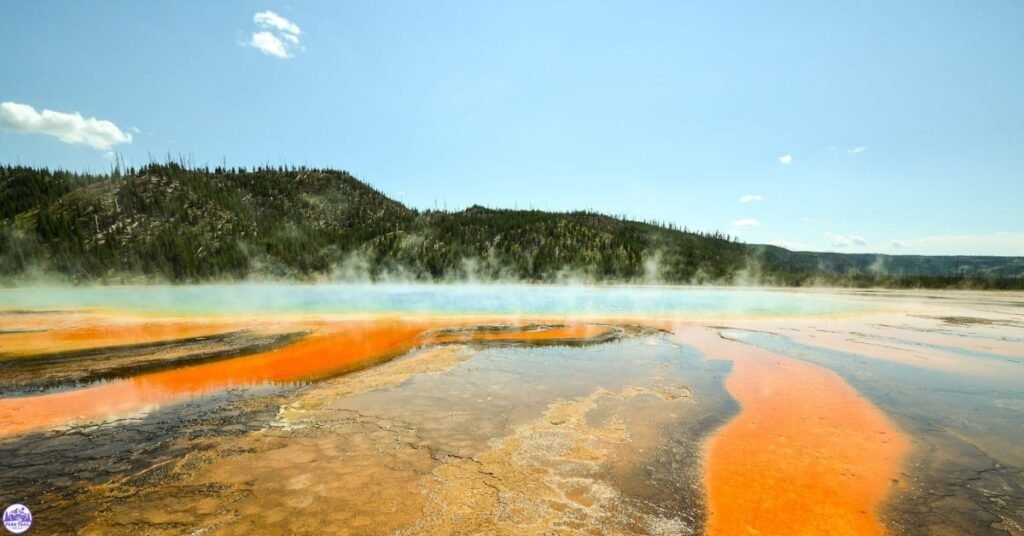
Yellowstone covers approximately 3,472 square miles, equivalent to about 2.2 million acres. That makes it one of the largest national parks in the United States.
The National Park Service (NPS) also points out that the park’s total area has not been scientifically verified. The commonly quoted figure is an estimate, rather than an exact surveyed measurement.
Yellowstone is larger than Rhode Island and Delaware combined, according to the NPS. However, the size of the park is easier to appreciate when you start driving between its major attractions.
There are five entrances: North, Northeast, West, South, and East. Each entrance provides access to a different part of the park, so choosing the right one can save considerable driving time.
The park’s main road network connects most major visitor areas through a figure-eight layout. Although the map may make some stops appear close together, driving between them can take several hours. Wildlife crossings, road conditions, parking, and photo stops all add time.
Here are some useful geographical facts:
| Yellowstone fact | Official figure or estimate | Why it matters |
| Total area | About 3,472 square miles | Plan your visit by region |
| Total land area | About 2.22 million acres | Do not expect to explore everything in one day |
| Entrance stations | 5 | Choose your entrance based on your first destination |
| Paved roads | 392 miles | Allow enough time for driving |
| Highest point | 11,358 feet | Conditions vary considerably with elevation |
| Yellowstone Lake elevation | 7,733 feet | Expect cooler conditions near the lake |
The practical takeaway is simple: Yellowstone is not a destination where you should plan every stop around a short estimated drive. Give yourself extra time, particularly during busy summer months.
Source: NPS Yellowstone Park Facts.
Yellowstone History Facts: How the First National Park Began
Yellowstone has a special place in the history of national parks.
On March 1, 1872, President Ulysses S. Grant signed the Yellowstone National Park Protection Act. Yellowstone became the first national park in the world as a result of this act.
However, the area’s human history began thousands of years before its official designation. Indigenous communities have long-standing connections to the land, its wildlife, plants, rivers, and thermal features.
Today, the National Park Service recognizes 27 associated Native American tribes with historical and modern connections to Yellowstone.
Another important moment came in 1870, when members of the Washburn expedition named Old Faithful. The geyser became one of the park’s best-known attractions and remains a major reason people visit Yellowstone.
Yellowstone has also attracted millions of visitors over the years. According to NPS visitation statistics, the park recorded 4,762,988 visits in 2025. Its current record remains 2021, when it received 4,860,242 visits.
These numbers help explain why famous attractions can become crowded, particularly during the middle of the day.
Three important dates to remember are:
- 1870: The Washburn expedition named Old Faithful.
- March 1, 1872: Yellowstone became the world’s first national park.
- 2025: The park recorded approximately 4.76 million visits.
For a deeper look at the area’s cultural and historical background, explore the NPS Yellowstone human history timeline and its Tribal Affairs information.
Yellowstone Supervolcano Facts: Should Visitors Be Worried?
Yellowstone sits above an active volcanic system. This is one of the reasons the park has so many geysers, hot springs, and other unusual thermal features.
The volcanic history is impressive. Scientists have identified three major caldera-forming eruptions in the Yellowstone region:
| Major eruption | Approximate age |
| First major eruption | 2.1 million years ago |
| Second major eruption | 1.3 million years ago |
| Most recent caldera-forming eruption | 640,000 years ago |
The most recent of these major eruptions created the Yellowstone Caldera, a large volcanic depression that measures approximately 45 by 30 miles.
Smaller volcanic events have occurred since then. The most recent lava flow in Yellowstone took place approximately 70,000 years ago.
Naturally, visitors sometimes wonder whether the Yellowstone supervolcano is overdue for another eruption.
The answer from the USGS is no. Scientists explain that volcanoes do not follow predictable eruption schedules. The two intervals between Yellowstone’s three major caldera-forming eruptions are not enough to establish a reliable cycle.
The USGS also reports that monitoring has not detected signs suggesting an eruption is imminent.
There is no reason to plan a normal Yellowstone vacation around fears of an imminent supereruption. The volcanic system is important to understand because it creates the thermal attractions that make the park unique.
Scientists continue to monitor the area using instruments that measure earthquakes and changes in ground movement.
For current scientific information, visit the USGS Yellowstone Volcano Observatory.
Yellowstone Geyser Facts That Explain the Boardwalks
Yellowstone is home to one of the world’s largest collections of hydrothermal features.
The National Park Service estimates that the park contains more than 10,000 hydrothermal features, including more than 500 active geysers. More than half of the world’s geysers are active.
The main types of thermal features visitors may encounter include:
- Geysers: These periodically release hot water and steam into the air.
- Hot springs: These contain heated water that remains in a pool or flows across the surrounding ground.
- Mudpots: These acidic features contain bubbling mud.
- Fumaroles: These release steam and volcanic gases from openings in the ground.
- Travertine terraces: These formations develop as mineral-rich water deposits calcium carbonate, particularly around Mammoth Hot Springs.
Different thermal areas offer different experiences.
Upper Geyser Basin
The Upper Geyser Basin is one of the most popular places to explore. It contains approximately 150 geysers within one square mile, along with hundreds of hot springs.
Old Faithful is the main attraction, but visitors can also explore nearby geysers and thermal pools using the designated boardwalks.
Midway Geyser Basin
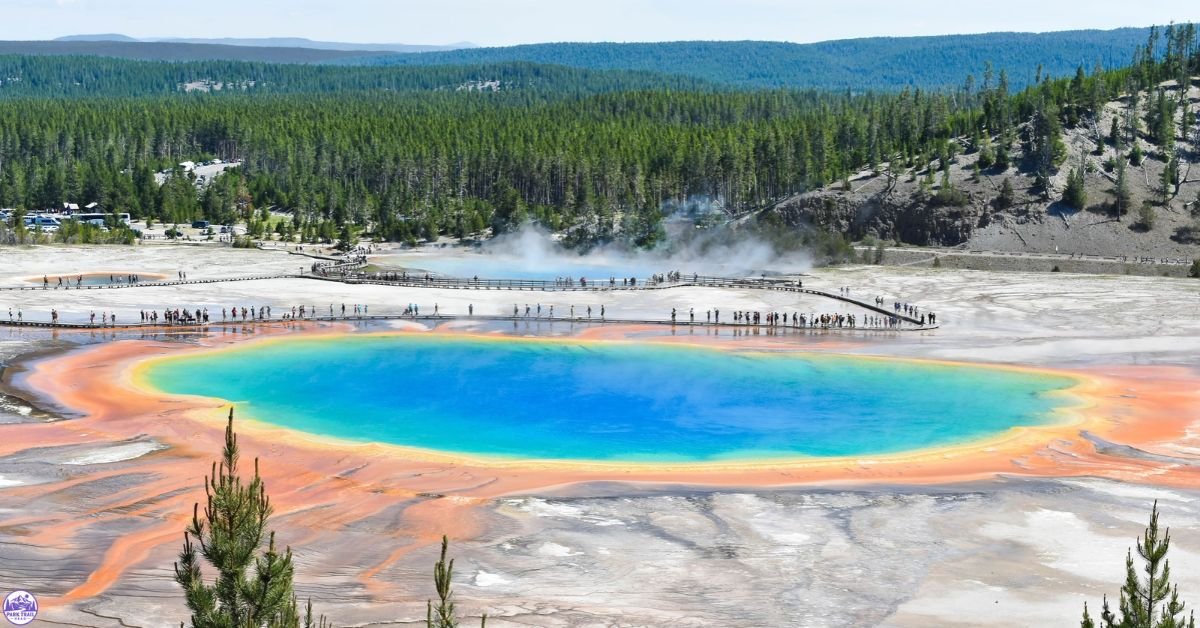
Midway Geyser Basin is approximately six miles north of the Old Faithful area. It is home to Grand Prismatic Spring, the largest hot spring in Yellowstone.
Its bright colors make it one of the most photographed locations in the park.
Mammoth Hot Springs
Mammoth Hot Springs is known for its distinctive travertine terraces. The landscape looks different from the traditional geyser basins, making it worth including in a first-time itinerary.
Why Staying on Boardwalks Matters
Yellowstone’s thermal areas are beautiful, but they can also be dangerous.
The ground surrounding hot springs may look solid but can have a thin crust covering extremely hot water. Burns can result from breaking through that surface.
The NPS reports that more than 20 people have died after entering or falling into Yellowstone’s hot springs.
For your safety:
- Stay on designated boardwalks and trails.
- Never touch thermal water or runoff.
- Do not throw coins, rocks, or other objects into geysers.
- Keep children close to adults.
- Do not swim or soak in hot springs.
- Keep pets out of thermal areas.
Following these rules also helps protect the fragile thermal environment.
Source: NPS Geysers and Hot Springs Safety.
Old Faithful Facts: Does It Really Erupt Every Hour?
Old Faithful is probably the most recognizable attraction in Yellowstone. Its name suggests that visitors can expect an eruption at a regular time, but its schedule is not quite that simple.
The geyser does not erupt exactly once every hour.
According to the National Park Service, the average interval between eruptions is approximately 90 minutes, although the time can vary from around 50 to 127 minutes.
Old Faithful is famous because of its relatively predictable eruptions, not because it is the tallest or most powerful geyser in the park.
An eruption typically lasts between 1.5 and 5 minutes and sends hot water high into the air.
Park staff regularly publish eruption predictions for Old Faithful and several other major geysers in the Upper Geyser Basin.
For visitors, the best approach is to check the latest prediction rather than assume the geyser will erupt at the top of every hour.
A few useful planning tips:
- Check the predicted eruption time at the visitor education center or through the NPS information channels.
- Reach the viewing area before the predicted time.
- Allow extra time if you have just missed an eruption.
- Use longer waiting periods to explore nearby boardwalks.
This makes it easier to enjoy the area without spending your entire visit waiting in one location.
Source: NPS Old Faithful Geyser Information.
Yellowstone Wildlife Facts and Safe Viewing Distances
Yellowstone is well known for its wildlife. Visitors may see bison, elk, wolves, bears, moose, pronghorn, and many other animals.
According to the National Park Service, the park supports approximately:
- 67 species of mammals.
- 330 species of birds.
- 16 species of fish.
- Five species of amphibians.
- Six species of reptiles.
Gray wolves were restored to Yellowstone during 1995 and 1996 after being absent from the park for several decades.
Although bears and wolves attract considerable attention, bison deserve special consideration.
Yellowstone’s bison cause more injuries to people than any other animal. They may look calm while grazing, but they can move much faster than people expect.
Bison also cause traffic delays when herds cross roads. These slowdowns are commonly known as bison jams.
The safest approach is to remain inside your vehicle and allow the animals to cross without trying to approach them.
Required Wildlife Viewing Distances
The National Park Service provides specific minimum distances that visitors must maintain.
| Wildlife | Minimum distance |
| Bears | 100 yards (91 meters) |
| Wolves | 100 yards (91 meters) |
| Cougars | 100 yards (91 meters) |
| Bison | 25 yards (23 meters) |
| Elk | 25 yards (23 meters) |
| Other wildlife | 25 yards (23 meters) |
These distances are safety requirements, not suggestions.
Carry binoculars or a camera with a zoom lens instead of approaching animals for photographs.
Yellowstone is also bear country. Anyone exploring hiking trails should carry bear spray and understand how to use it before heading out.
For more information, read the official Yellowstone wildlife safety guidelines and NPS wildlife guide.
Yellowstone Lake and Waterfall Facts
Yellowstone is not just about geysers and wildlife. It also has impressive freshwater landscapes.
Yellowstone Lake is one of the park’s most recognizable natural features. It covers approximately 131.7 square miles and has about 141 miles of shoreline.
The lake sits at an elevation of 7,733 feet above sea level, making it the largest lake in North America located above 7,000 feet.
It is also a place where visitors need to respect the water conditions. Even during warmer months, the lake can be extremely cold, and its weather can change quickly.
Swimming is not recommended in most Yellowstone lakes and rivers. Cold water, changing conditions, and fast-moving currents can create serious hazards.
Yellowstone’s Waterfalls
The park has approximately 290 waterfalls.
One of the most famous is Lower Falls in the Grand Canyon of Yellowstone. It drops approximately 308 feet and is the tallest waterfall near a road in the park.
Another well-known waterfall is Gibbon Falls, which drops approximately 84 feet.
These locations offer different views of Yellowstone’s landscape and are excellent additions to a first-time itinerary.
When visiting waterfalls, stay behind barriers and use designated viewpoints. Wet rocks, steep edges, and fast-moving water can make seemingly safe photo locations dangerous.
Sources: NPS Yellowstone Park Facts and NPS Yellowstone Lake Information.
Yellowstone Elevation and Weather Facts for Hikers
One detail that many first-time visitors overlook is Yellowstone’s elevation.
Most of the park sits at an elevation of 6,000 feet or higher. Yellowstone Lake alone is located at 7,733 feet.
Visitors arriving from low-elevation areas may notice that walking uphill feels more demanding than expected. This is particularly important when planning longer hikes.
You do not need an ambitious hiking schedule to enjoy Yellowstone. Start with shorter walks and boardwalks, allow time to rest, and increase your activity gradually.
Weather is another reason to prepare carefully.
At Mammoth Hot Springs, the NPS lists average daily temperatures of approximately:
| Month | Average daily temperature |
| January | 9°F (-13°C) |
| July | 80°F (27°C) |
These figures describe Mammoth, not every location in the park. Higher elevations and exposed areas can experience considerably colder conditions.
Yellowstone has also recorded an extreme low of -66°F (-54°C), measured at the West Entrance in 1933.
Even in summer, afternoon thunderstorms are common, and nighttime temperatures can drop considerably.
A practical packing list should include:
- A warm jacket or insulating layer.
- A waterproof rain jacket.
- Comfortable walking shoes with good grip.
- Sun protection.
- Reusable drinking water bottles.
- Extra layers for colder mornings and evenings.
Check the forecast before each hiking day, because conditions can change quickly.
Source: NPS Yellowstone Weather Guide.
Yellowstone Driving Facts: Why You Need More Time Than Expected
Driving is an important part of nearly every Yellowstone vacation.
The park’s main road network connects its major attractions, entrances, visitor areas, and trailheads. The Grand Loop forms a figure-eight pattern and provides access to many of the best-known locations.
However, driving in the park is not the same as driving on an ordinary highway.
You may encounter:
- Bison or elk crossing the road.
- Traffic congestion around popular viewpoints.
- Limited parking at busy attractions.
- Road construction or temporary closures.
- Slow-moving vehicles and reduced speed limits.
- Extra time needed for walking trails and viewing wildlife.
The NPS notes that it takes several hours to drive between Yellowstone’s entrance stations.
This is why a route that looks manageable on a map can take most of the day once you include stops.
Instead of attempting to cover the entire park in one day, divide your itinerary into geographical areas.
For example, you could explore Mammoth and the northern range on one day, then focus on Canyon Village and the waterfalls on another.
Always check the official Yellowstone road status page before starting a driving day.
Yellowstone Seasonal Facts: What Is Open During Each Season?
The time of year you visit Yellowstone has a major effect on which parts of the park you can explore.
Summer offers the widest access to regular vehicle roads, while winter provides a very different experience with limited road access and snow-based transportation.
Winter: November Through March
Winter changes how visitors move around Yellowstone.
For the 2026–2027 winter season, most park roads and the West, South, and East entrances closed to regular vehicle traffic on November 1, 2026.
The North Entrance-to-Northeast Entrance corridor remains open to regular vehicles throughout the year, weather permitting.
This route connects Gardiner with Cooke City through Mammoth Hot Springs, Tower Junction, and Lamar Valley.
Snowcoach and snowmobile travel on designated oversnow routes begins on December 15, 2026, with individual road sections following their published opening schedules.
Winter visitors should expect limited services, snow-covered roads, and possible weather-related closures.
Spring: April and May
Spring is a transition period.
Roads reopen in stages, and opening dates depend on weather and snow conditions. Some areas may be accessible while other roads remain closed.
Wildlife activity increases, but visitors should still prepare for cold mornings, snow, and changing weather.
Summer: June Through August
Summer provides access to most of Yellowstone’s road network.
It is also the busiest season, with heavy visitor traffic, crowded parking areas, and more competition for accommodation.
Starting early in the morning can make a noticeable difference at popular attractions.
Fall: September and October
Fall offers cooler temperatures and a different atmosphere.
Wildlife activity can be excellent, and some popular areas become less crowded as the summer season ends.
However, road closures begin as winter approaches. Visitors planning an October trip should always confirm seasonal schedules before traveling.
The important thing to remember is that Yellowstone’s opening and closing dates can change.
For the latest information, check the NPS Park Roads page.
Yellowstone Entrance Fees and Pass Facts for 2026
Entrance fees are another important part of planning a Yellowstone vacation.
For 2026, a standard private vehicle entrance pass costs $35 and is valid for seven consecutive days. It covers the vehicle and its passengers.
Other standard entrance options include:
| Entrance option | 2026 price |
| Private vehicle | $35 |
| Motorcycle | $30 |
| Individual entry on foot or bicycle (age 16+) | $20 |
| Yellowstone annual pass for eligible US residents | $70 |
| America the Beautiful annual pass for US residents | $80 |
| Non-Resident America the Beautiful annual pass | $250 |
There is also an important 2026 fee change for international visitors.
Non-US residents aged 16 and older must pay an additional $100 per person when visiting Yellowstone, unless they enter with a qualifying Annual or America the Beautiful pass.
This means international visitors should calculate the total cost for their group rather than looking only at the standard vehicle fee.
For example, a family traveling in one private vehicle may pay the regular vehicle entrance fee plus the additional nonresident fees for eligible family members, unless covered by a qualifying pass.
The America the Beautiful pass can be useful for people visiting several participating national parks and federal recreation sites during the same year.
Yellowstone does not require a vehicle reservation for ordinary park entry, but an entrance pass is required.
These figures are for 2026 and should be checked again before a 2027 trip.
For exact prices and eligibility rules, visit the official NPS Yellowstone Fees and Passes page.
Five Yellowstone Travel Mistakes These Facts Can Help You Avoid
Knowing Yellowstone’s basic facts is useful, but applying them to your itinerary is even more important.
Here are five mistakes that can make a first visit more stressful than necessary.
1. Expecting Old Faithful to erupt exactly every hour
Its average interval is around 90 minutes, and actual intervals vary. Check the latest prediction rather than relying on an assumed schedule.
2. Trying to explore the entire park in one day
Yellowstone is too large for a relaxed one-day visit. Select a few nearby attractions instead of spending most of your time driving.
3. Leaving the boardwalk for a photograph
Thermal ground can collapse, exposing visitors to dangerously hot water. Always remain on designated paths.
4. Getting too close to wildlife
Bison, bears, wolves, and other animals are unpredictable. Follow the required viewing distances even when an animal appears calm.
5. Assuming every road remains open throughout the year
Seasonal closures affect access to major attractions. Check the official road schedule before planning each day’s route.
A little preparation can prevent these problems and help you enjoy more of the park.
A Practical Four-Day Yellowstone Itinerary Based on These Facts
If you are visiting Yellowstone for the first time and the main road network is open, four days provide a useful starting point.
Rather than trying to visit every attraction, the group stops by location.
| Day | Main area | Suggested activities |
| Day 1 | Mammoth Hot Springs and northern range | Explore the terraces and look for wildlife |
| Day 2 | Canyon area | Visit the Grand Canyon of the Yellowstone and Lower Falls viewpoints |
| Day 3 | Upper and Midway Geyser Basins | Watch Old Faithful, explore boardwalks, and visit Grand Prismatic Spring |
| Day 4 | Flexible exploration | Revisit a favorite area, explore Yellowstone Lake, or allow extra time for wildlife viewing |
This schedule assumes the main roads are open and weather conditions are suitable.
A flexible fourth day is particularly useful because wildlife-related delays, parking congestion, and unexpected closures can affect the original plan.
If you only have two days, avoid trying to drive the entire park. Focus on the Upper Geyser Basin and the Canyon area, adjusting the route to your entrance and current road conditions.
Visitors interested in backcountry camping or longer wilderness hikes will need additional research and permits where required. This beginner-friendly itinerary is designed primarily around Yellowstone’s main visitor areas.
Frequently Asked Questions About Yellowstone
Is Old Faithful the biggest geyser in Yellowstone?
No. Old Faithful is not the tallest geyser in the park. It is famous because it erupts more frequently and predictably than many other major geysers. Its average interval is approximately 90 minutes, although actual times vary.
Will the Yellowstone supervolcano erupt soon?
Scientists cannot predict the exact timing of future volcanic activity. The USGS says Yellowstone is not overdue for another major caldera-forming eruption and has not detected signs suggesting an eruption is imminent. Visitors can check the Yellowstone Volcano Observatory for scientific updates.
How many days should you spend in Yellowstone?
Three to five days is a reasonable target for many first-time visitors. Three days allow you to explore several major areas, while four or five days provide more flexibility for wildlife viewing, walking trails, and changing weather conditions.
Can you bring a dog to Yellowstone’s geyser basins?
No. Pets are not allowed on Yellowstone’s boardwalks, hiking trails, backcountry areas, or in thermal areas. This restriction also applies to pets being carried in backpacks, strollers, or arms.
Pets are generally limited to developed areas and must remain within 100 feet of roads, parking areas, and campgrounds while under physical control. Trained service animals have different access rules.
Read the official NPS Yellowstone pet regulations before traveling with a dog.
Is Yellowstone open throughout the year?
Yes, Yellowstone remains open throughout the year, but access is very different by season. Most roads close to regular vehicle traffic in early November, while the road between the North and Northeast entrances generally remains open year-round, depending on weather. Some interior roads reopen for oversnow travel during winter.
How many geysers are in Yellowstone?
Yellowstone has more than 500 active geysers, representing over half of the world’s active geysers. The Upper Geyser Basin alone contains approximately 150 geysers within one square mile.
Final Thoughts: Plan Yellowstone as a Region, Not a Single Stop
Yellowstone is a remarkable national park, but its size, elevation, wildlife, and seasonal road closures make planning especially important.
The most useful facts are the ones that help you make practical decisions. Allow enough driving time, check geyser predictions, prepare for changing weather, and respect wildlife and thermal-area safety rules.
For a first visit, three to five days is a good starting point. Divide your itinerary into nearby areas and leave some flexibility for unexpected delays.
You do not need to see every attraction to have a rewarding Yellowstone vacation. A well-planned visit that gives you time to enjoy the geysers, waterfalls, wildlife, and scenery will usually be more satisfying than rushing from one stop to another.
Before leaving, check the official NPS pages for road conditions, entrance fees, weather, and safety updates. These details can change, and current information is always more useful than an old travel schedule.
Author Bio
Awais is the Founder and Editorial Director of ParkTrailsGuide. Working with a network of outdoor contributors and current park data, he creates deeply researched survival guides, packing frameworks, and safety blueprints for U.S. national parks. His mission is to turn complex official National Park Service data into clear, actionable travel resources.
1 thought on “Facts About Yellowstone: What the Numbers Mean for Your Trip”